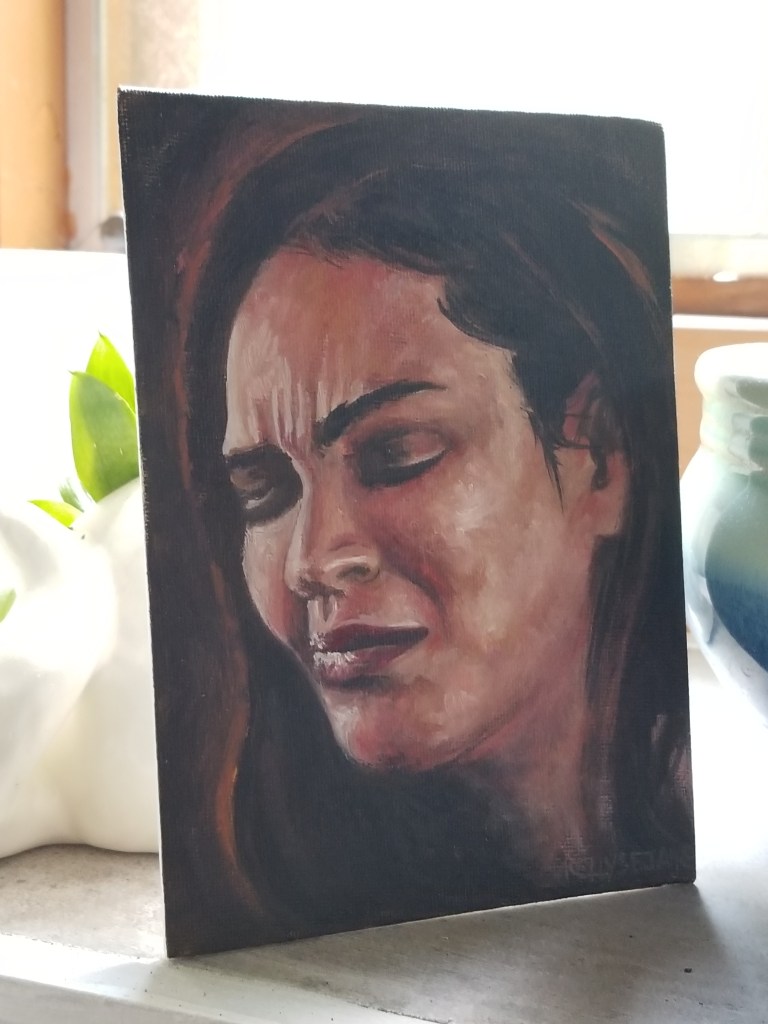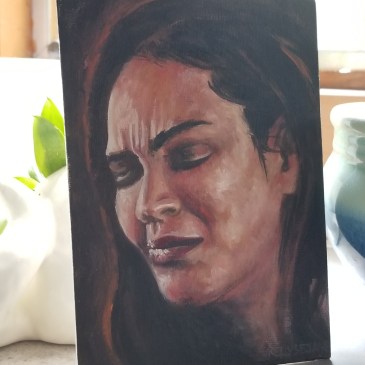
Pain has a thousand faces.

I had to go to a doctor recently. The why of it doesn’t matter so much as some of the questions that I was asked while I was there. I don’t recall ever having a health care professional ask me questions about my emotional well being as much as they did that day. I was asked if I was feeling OK. I was asked if I was experiencing heightened anxiety. I was asked if I had any feelings of despondency or hopelessness.

I know logically that these questions are now part of the patient interview because of the quarantines for Covid19 and how it is affecting people’s mental state. I must admit that I found it rather reassuring. I felt completely listened to, and cared for in a way that I don’t often feel when speaking to someone other than my husband.

I answered candidly and perhaps even a bit flippantly. Afterwards, I also found it left me somewhat unsettled because it made me do another level of self evaluation. How am I feeling? How am I dealing with heightened anxiety? Have I been feeling despondent or stretched thin? It made me uneasy because I realized I am actually struggling with these things.

I had jokingly said that I turn to my painting to help me with anxiety, and that is partially true. In fact, painting does help me sometimes but when I am feeling at my worst I can’t seem to paint at all. I feel frozen, and the panic escalates. Looking at me, however, you wouldn’t know I am struggling.

Just like when someone has an underlying illness that others don’t know about, emotional illness can also be very invisible. A person can seem calm and solid with a smiling face and yet be consumed with pain. We make misasumptions every single day of our lives. We look at the faces around us and make assumptions of their state of affairs based on the appearance they present. We assume they are happy, calm, confident, well, or any one of a hundred other human conditions based on the mask of that face. Inside, however, the person may be suffering undescribable pain for any number of reasons.

We must never make those assumptions. We need to ask, and we need to listen to the responses. As you look around at the people you encounter every day, remember any of them could truly be the face of someone in pain.

This painting is a 5″ x 7″ study, oil on canvas board titled, “Pain”.
Listening actually needs quiet.

Sometimes we make the most noise when we are crying for quiet. In fact, we make so much noise seeking quiet that we can’t hear it… or should I say, recognize it.

These are such usual times that we’re living in right now. I know how I feel and it is hard. I am confused, and tense, and fearful of illness, and so wishing that I had my routines back. Routines are comforting. I can’t help but wonder if other people aren’t feeling the same way? It seems like it.

I pride myself in being someone who is pretty fairly organized, logical, and methodical to a fault. I look for things to help me be calmer and quieter to avoid being tense and grumpy towards the people around me because I know that neither they nor I are truly upset with each other, but instead are upset with our lack of control in our lives.

Today I thought alot about my father and remembered I used to have conversations with him about quiet. He would talk about being able to listen to the guidance that comes from your inner voice, or from God’s still small voice. He used to say, “you can’t hear good direction when you’re making too much noise. Try thinking about a shore and listening to the slow pattern of the waves”. These days I look for that calming of the waves by walking in the woods, going some place that has a serenity to it, or doing an activity that is slow paced. Whether it’s a place outdoors, or my back porch, or a place in my house that allows me to do some introspective thinking, I have to make that effort to seek it out.

When I sit at my easel and I paint, that is one of those places where I can think. In thinking, once you’re past the superficial and immediate, you begin to follow a deeper path. Introspective thinking is when you start being truly objective and even critical of all of your thoughts and emotions, and how they are dictating your outward actions. Here you can identify and calm those that you don’t want controlling you. Think about statements you make, attitudes you have, tensions that are running astray for you. As I calm those core parts of myself at the easel, my painting is an access to spiritual thought, and prayer.

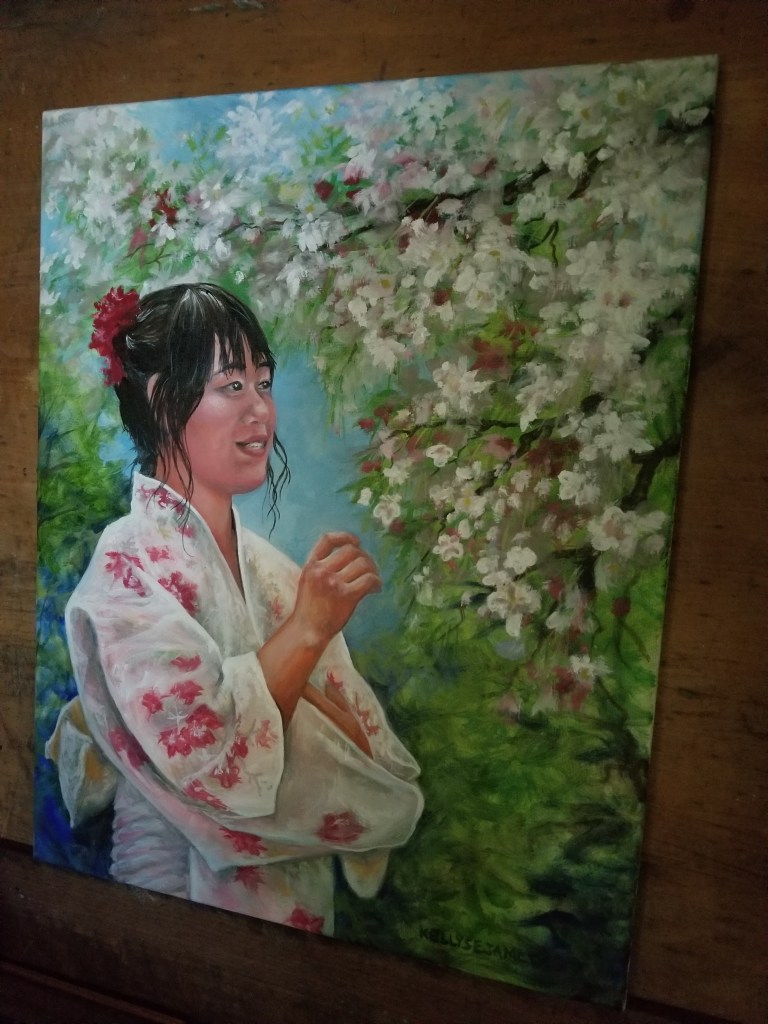
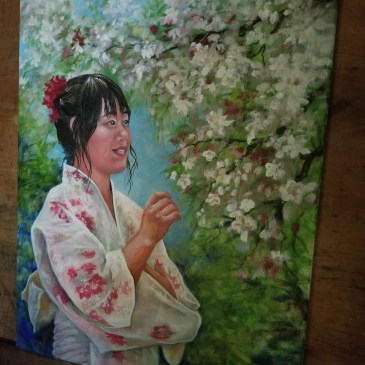
The painting that I’ve been working on for the last 2 days has been purely an exercise in centering. It is a marriage of the loose style I admire in the plein-aire artists and the illustrative style that calms me. Most importantly, it was my tool for self reflection.

My thanks to a friend who gave me permission to use her likeness. I hope you enjoy this 16″ x 20″ oil on canvas. “Spring blossoms”

Traveling from home

Saturday mornings are a great time to just take a minute, relax, and think about places I’ve gone. I pour a cup of coffee and kick back in the recliner on the back porch. The light is soft and crystaline and bounces off the dew on the ferns, making a galaxy of stars on the fronds moving in the breeze. The colors and textures and light all make it easy to daydream of places I have travelled.

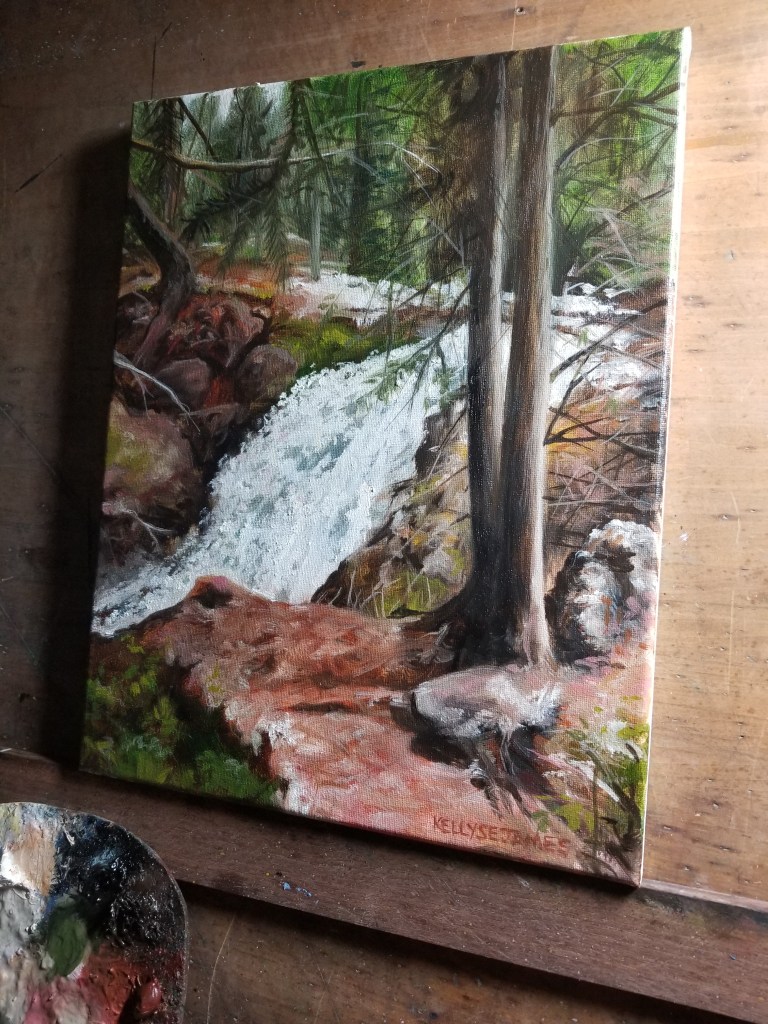
This morning I was remembering our wonderful driving trip to the western states with the van camping and the stunning scenery. As I have said before, I take pictures. Inspired by the morning and my memories of the trip, I scrolled through the album and stopped to smile on this one.

Waterfalls are a fascination to me with their energy and fresh misty air. Surrounded by pines we stood on this small cliff and enjoyed the view, the sounds and the smells for a bit. It was a lovely afternoon, and a memory worth capturing on canvas.

This painting is an 11″ x 14″ oil on canvas called “Morning Smile”.

Capturing fleeting moments with paint.

I love to take photos. Photography is an art form, and a source of inspiration, and a tool to document and keep.

Anyone who knows me knows that I can almost be annoying with the way I try to capture moments of my daily life with my camera phone. I’m not just talking about those cheesecake moments when you throw your arm around a friend and you do the selfie, nor am I just talking about that moment when you take the shot of the lovely plate of food in front of you because it’s exceedingly colorful, or displayed well, or you love the cook. No, I mean I take pictures of anything from tiny flowers to a sunrise. I have thousands of photos that no one will probably ever see.

I celebrate every fabulous day. For me, each day prompts that same sense of awe that you get when you’re on an amazing vacation and you see a mountain for the first time. From the truly grand to the most wee detail, everything is just a marvel to me.

Plein aire painter’s, by their very nature, have really popularized the process of capturing the outdoors with something other than photography. By using the painting process it can elevate even the most mundane into a final piece of art and show the relationship, or presence of the artist. I have been quite enthralled with the concept of trying to capture those moments on the hoof, so to speak, and I’ve had some real fun with it. There is something about this work that sits in that spacial energy between photography and the fleeting impression of a moment. It is modern impressionism.

I enjoy making paintings in the field, with all of the unique challenges of time and changing weather. Looking at them afterwards I like that they have such a particular sense of light and energy. It feels like much harder work because of the speed necessary to see, process, and work the images and I greatly admire artists who work primarily en plein aire.

The influence of working more impressionistic and loose has certainly improved my work but I think I will always find my true comfort anchored firmly in the studio. Moreover, I think I am hard wired (or cross wired if you’d prefer), between a classical representational style and one of commercial illustration. For me, paintings continue to be illustrations of my life or observation of my world.

So that being said, today’s painting has been lingering on the easel where I could dithered with it in my free times this week. Time, tucked into the evenings or bracketed between zoom meetings, could be spent in snippets of time merely to unwind. I know, a photograph would have captured it just as well… probably better. But for me these literally become more about the immersion in the process of painting, of reliving a memory, or even about reflecting or meditating on something not clearly related to the image itself. That’s when it can become prayer.

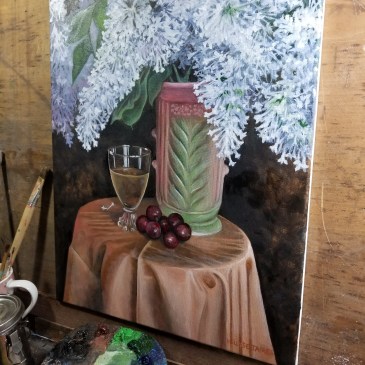
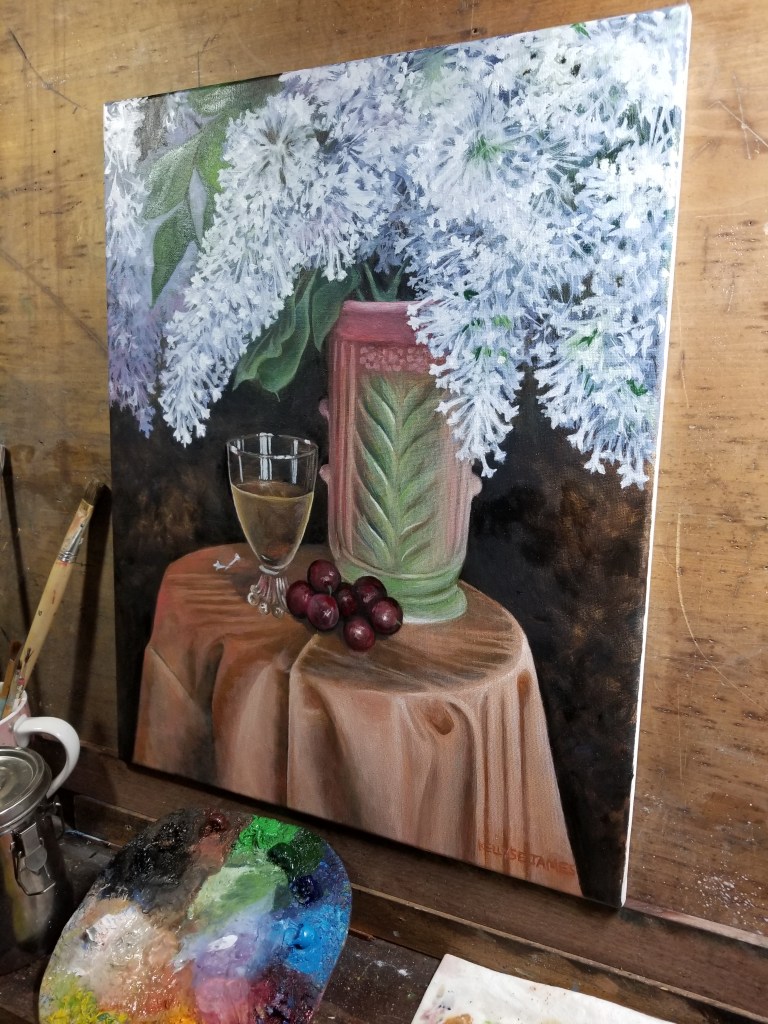
For your enjoyment, breath deeply and enjoy the remembered scent of “Lilacs” a 16″ x 20″ oil on canvas.

Hope must prevail.

I paint for enjoyment…. for personal pleasure and love of color and light.

I also paint to find my peace. I paint to remain calm. I paint to find my way through my racing thoughts and to articulate the emotions that flow through me like an undisciplined mountain stream.

And I paint to pray.

I pray that good will always defeat evil, and that hope must prevail.

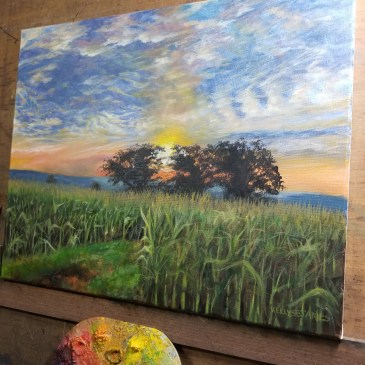
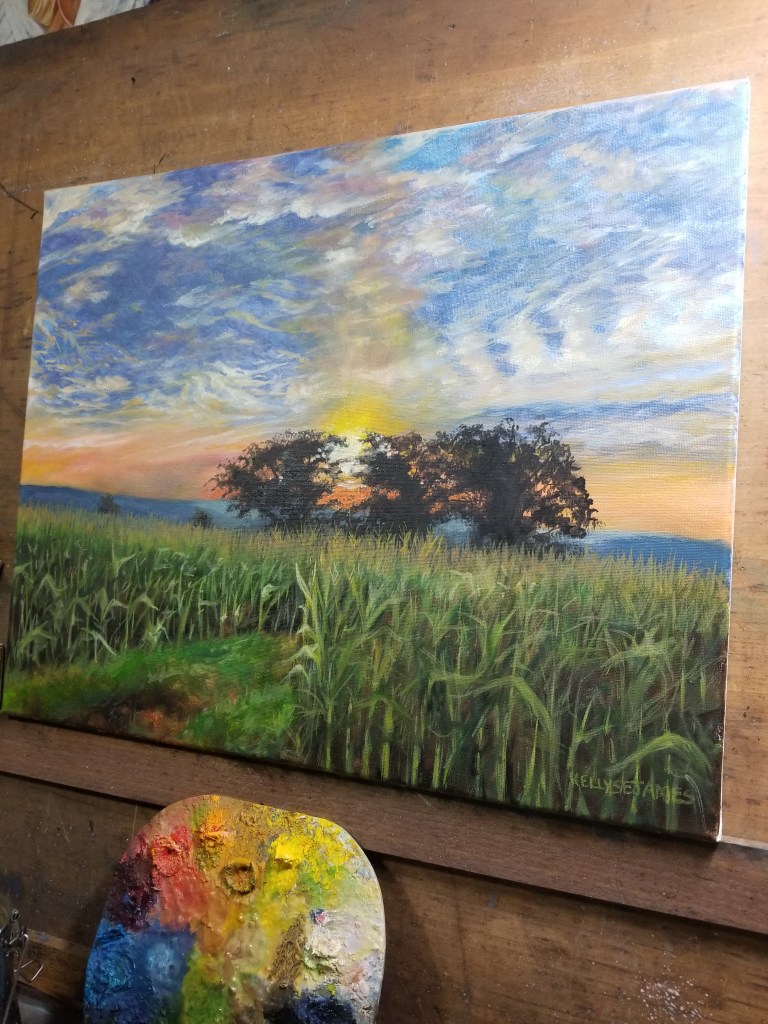
This piece is oil on canvas, 20″ x 16″ of a sunrise on the farm of dear friends in Wisconsin called “The Promise of Hope.”

Simple, or not.

We sometimes like to speculate that we understand the complexities of life. We may even brag that we have a handle on what all is going on around us. We try to make everything binary, black or white, an either or scenario. There’s a confidence in that thinking that tries to make things as simple as possible and thereby easily understood. Our logical minds know that nothing is that easy but we want it to be, so very much.

There is good and there is bad, and there is left and right, but it is the indefinite layers in between that is unsettling because it is not easily labeled. Like onion skin, the layers are indefinite and the variations that make life messy and multifaceted. It is not simple, actually.

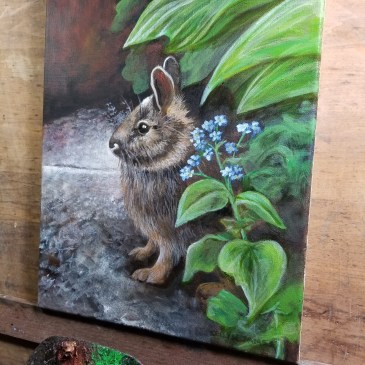
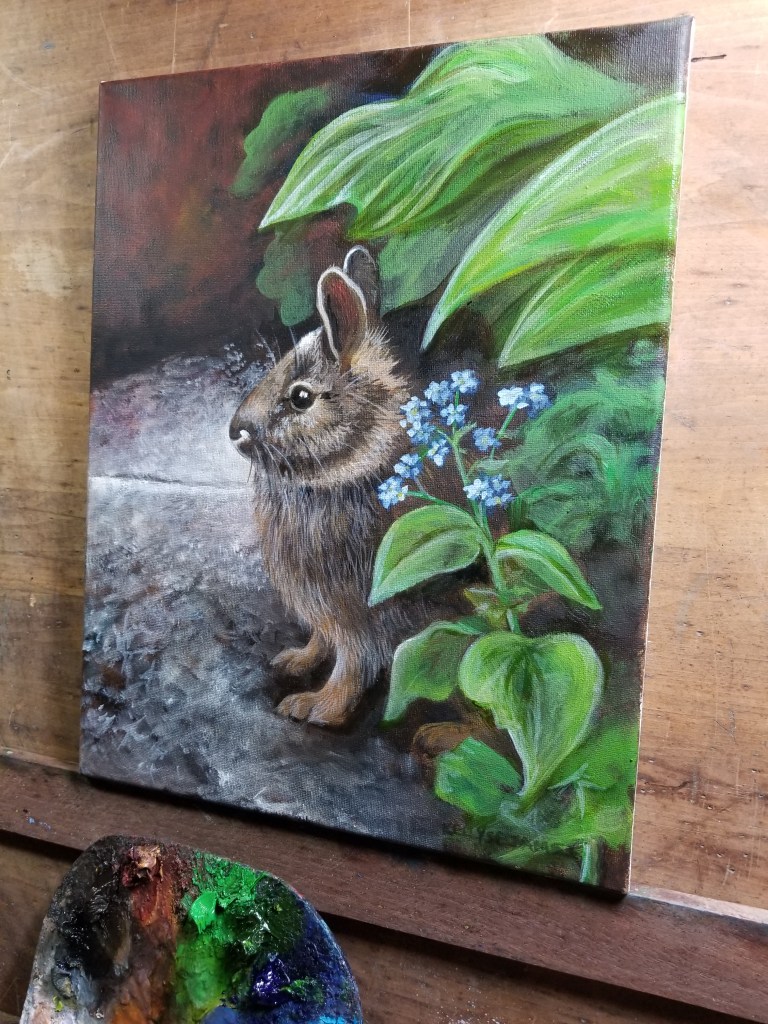
I had looked out my kitchen window the other day and was enjoying the birds on the feeders and the grape jelly, enjoying the false forget-me-nots (bernerra) blooming in the yard, enjoying the fact that the hostas didn’t get ruined in the recent hard frost. I also enjoyed watching a tiny bunny who apparently survived the extinction of his other nest mates. Now, I don’t necessarily enjoy having full grown rabbits treating my gardens like an all you can eat salad buffet but little bunnies are just too cute to get mad at. I’ve been out there weeding and almost put my hand on him, and as time has gone along I have enjoyed seeing him approach what I’d call pre adolescence, where he was a little more flighty, a little more brazen, and knew the channels under the hostages so well that I rarely encountered him but only saw him from a slight distance. I was telling a friend of mine on the phone about the bunny in the yard and realized that I had started to amorphize him.

Then, the other day I decided to do a quick study of him because bunnies are, like I said, pretty cute. So I put up a canvas, painted and got almost done before stopping for supper. As I stood in the kitchen talking to my husband we heard the unmistakable sound of a larger animal crashing through hosta leaves and then the unmistakable noise that a rabbit can make. I knew what it was in an instant and ran to the kitchen window to see a feral cat from the neighborhood racing down the sidewalk toward the alley with something larger in its mouth.

I can’t dwell on it. I hate to think about it. I know my pendulum is swaying from far left to far right and back. I know that it is the way of nature. I don’t believe in people letting their cats roam. Everthing deserves a right to live. It is the balance of nature and God’s call, but the bottom line is it began to represent our lack of control in our current environment. We can’t control the feral cat. We can’t control life-and-death. We can’t control anything but our own actions and our response to the uncontrollable.

I was sad for a bit, and then finished the little study in hommage to the wee bunny for he made me happy for our short part in it all.

For your enjoyment, the painting is an 11×14 oil on canvas called, “Hommage”

Missing our historical friends.

Ordinarily, this time of the year reenactors get together in great celebretory encampments all over the United States to talk history, smell good wood smoke, buy fine wares from historical craftsmen, and catch up on what everyone has been up to. History lovers have such a wide variety of special interests to bring to the table and in the living history communities especially, the variety is broad. Living history reenactors are often full time professionals in the trades, or we are teachers, doctors, librarians, artists or a myriad of other roles, but our common ground is a love of history.

Spring is the time to share about what we’ve researched over the winter, show what we’ve created or built, and to brag on new attire we have sewn. We talk of hunts, and purchases, new babies and the passing of old friends.

Like any close knit community, and believe me living history reenactors are a close knit family, we miss each other. We talk about seeing each other on Facebook and we call each other on the phone and we sit around in zoom and face time rooms showing each other quillwork and leatherwork and paintings …talking about when this will be over.

It’s hard… but we count on knowing that hard times pass. I have dozens of people that I only see in these settings but find myself extremely fond of. Some are brilliant and loving individuals, from all walks of life, and all capabilities, and all denominations of faith, and representing all of the peoples of mankind.

Unfortunately, the economic effects of this widespread illness may be the undoing of some small businesses in historical communities. In these new and unusual times of staying safe by staying away from each other, the living history communities cannot orchestrate large gatherings of camping historians (often a 100 or more tents) in a field or two. With events cancelling, the vendors in camp who have sown and hammered and created all Winter cannot now sell their wares to the other living historians. This is not just a hobby for them and these people do not have other professions. Living history IS their small business. Still they must pay their mortgages and buy their food just as any local small business owner we know must do.

It’s a helpless feeling to not be able to help small businesses in times like these. We find ourselves doing curbside pick up at our favorite restaurant knowing that it may help them sustain.

When you think of ordering online, I would encourage you to think about some of the small living history based businesses, artisans, and craftspeople you know and reach out to their websites. Look at what they’ve been doing and purchase directly on their secure sites. Help these historians who support themselves in a small business.

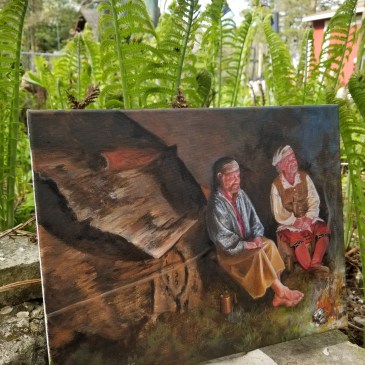
Today’s painting is a reminiscent little study, oil on canvas, of two of my friends sitting around a campfire at an event last summer. It is titled, “It was a good day, wasn’t it? “.

More fairie folk, or painting daydreams.

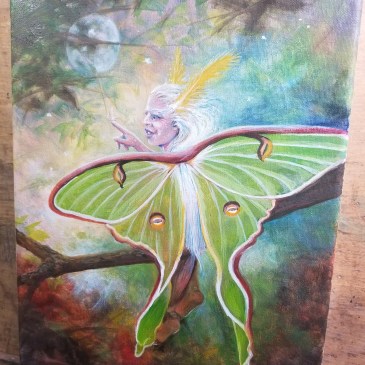
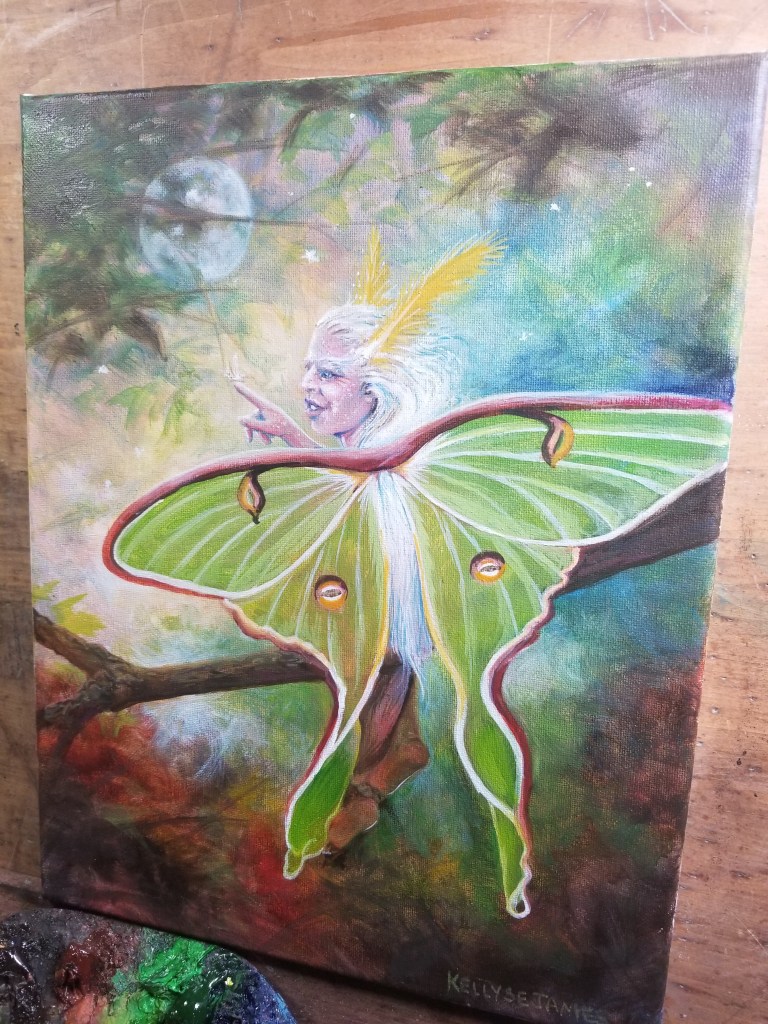
There is no great philosophical meaning or story behind this painting. I needed to paint, and I didn’t know what to paint, and my palette needed cleaning, and what was left was limited… so I decided to paint a luna moth. Then I realized I was bored with it and started to run off the rails into fantasy again.

So, this is just about pushing paint around, thinking about relaxing times camping in summer and the wonderful insects we marveled at as kids.

This is a small, oil on canvas called, “Namesake”

Workflows and other new regimes.

“Make peace with imperfection”. This is one of the phrases I took away from an online teaching group discussion I attended today. While certainly a true phrase for trying to deliver content in an online teaching environment, especially if the transition has been rapid and without warning like this Spring has been, it hit me how applicable it is in painting. I am notorious for worrying a subject to death and not stopping soon enough, thereby striving for perfection and falling terribly short.

I also know that another phrase that came out of that meeting, “less is more” (remeniscent of Meis logic) is also applicable. Instead of trying to show everything that you are capable of as a painter in one piece, stick to the synthesis, or simple way. It’s exactly what plein aire is all about. In that style you look, judge, synthesize, and quickly capture the impression of what you’re seeing. Small studies in the studio follow the same principle. So while I’m listening and watching a zoom meeting, my mind is jumping to a next lesson on canvas.

Our new normal is a blend of teaching and learning with one job and having that job be embedded in your home environment, complete with all of the new tasks and precautions of the pandemic. When we get groceries they come into the house and get processed in an assembly line of wiping and disinfecting and all fresh produce gets washed in the stainless steel sinks and dried in the drainer.

Timing in learning is part of the integration process. My worlds collided today. If you need subject matter for your paintings, you are literally surrounded by thousands of chances to ply your trade. Today’s painting is the merge of what I learned in my meetings and what we now do in our home work flow.

This piece is an 8 by 10 oil on canvas called, “Quarantine Still-life” (or, now everything gets washed)